
With the cash rate at 4.85% and home values falling, refinancing is no longer just about chasing a lower rate. Here’s what switching really costs, how to work out your break-even point, and the traps to avoid.
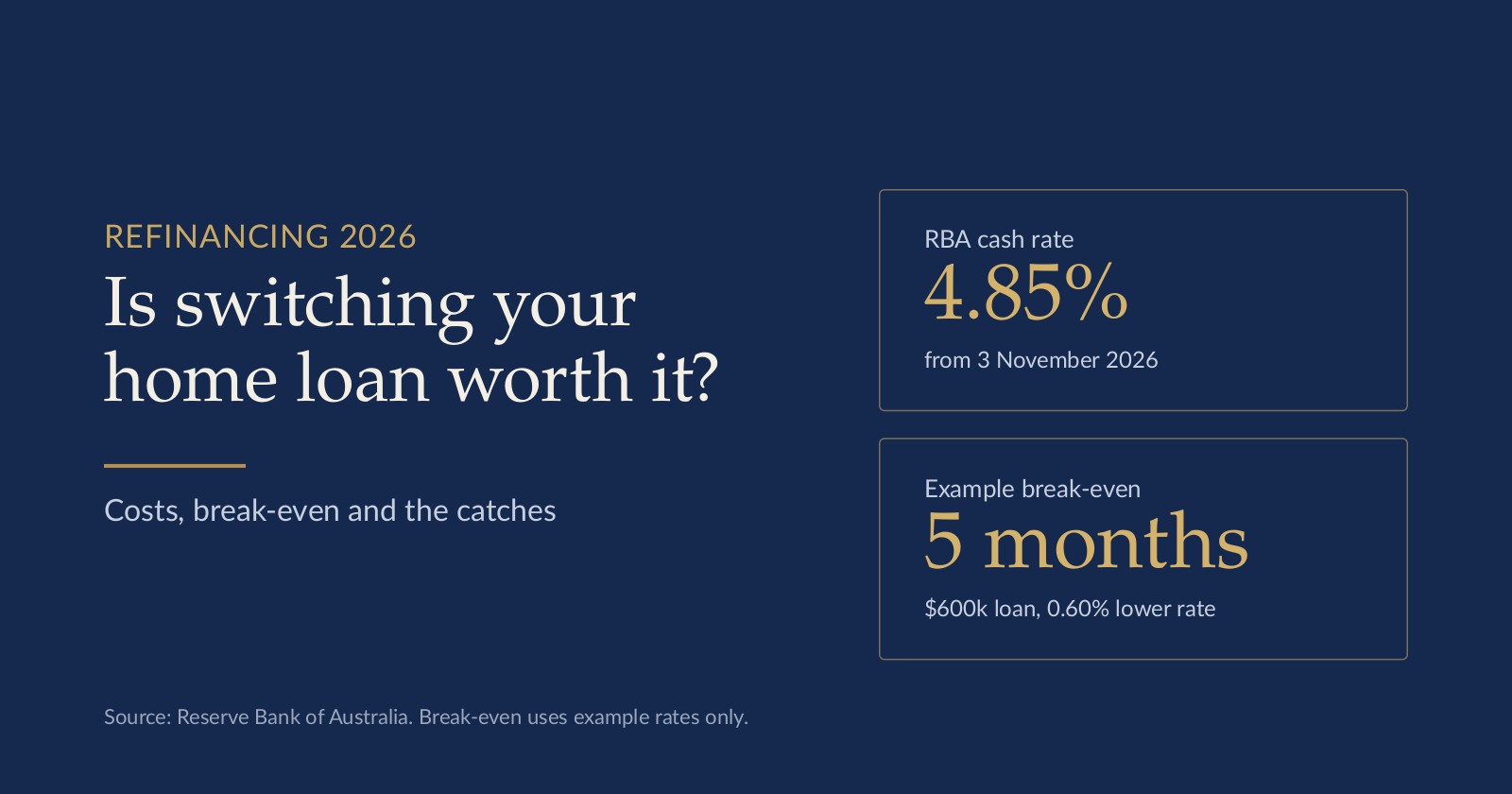
On 3 November 2026 the Reserve Bank raised the cash rate by 0.25% to 4.85%, its highest level since 2008 (RBA). Most lenders pass increases on to variable rates within a few weeks, so many borrowers are paying noticeably more than they were at the start of the year.
At the same time, the RBA notes that housing prices have fallen significantly. Capital city values were down 4.8% over the year to October, according to Cotality (see our November property update). That matters because the new lender values your home before approving a refinance. A lower valuation means a higher loan-to-value ratio, which can affect the rate you’re offered and whether you need lenders mortgage insurance.
The gap between lenders is still wide. ASIC’s Moneysmart notes that variable rates on the market can differ by more than 2% (Moneysmart). So refinancing can still be worthwhile, but the numbers need checking more carefully than when rates were falling.
Before you switch, call your lender and ask them to review your rate. Tell them you’re considering moving and, ideally, quote a specific rate from another lender. Lenders often reduce the rate for existing customers to keep them, particularly if you have at least 20% equity and a clean repayment history. If they match or come close, you save without paying any switching costs.
These are the usual costs of refinancing a home in NSW:
| Cost | Typical amount | Who charges it |
|---|---|---|
| Discharge (termination) fee | Often around $350 | Your current lender |
| Register the discharge of mortgage | $182.73 | NSW Land Registry Services (2026/27) |
| Register the new mortgage | $182.73 | NSW Land Registry Services (2026/27) |
| Application, settlement or valuation fees | $0 to about $600 | New lender (often waived for refinancers) |
| Fixed-rate break cost | Nil to many thousands | Current lender, if you’re in a fixed term |
| Lenders mortgage insurance | Can be thousands | New lender, if your loan is over 80% of the value |
Government fees: NSW LRS fees from 1 July 2026. NSW doesn’t charge stamp duty on a refinance.
If you’re on a fixed rate, ask your lender for a written break cost quote before doing anything else. When rates have risen since you fixed, the break cost is often small or nil; when they’ve fallen, it can be large.
Your break-even point is how many months of savings it takes to recover the switching costs. Here’s an example using example rates only:
Run your own numbers with our refinance calculator.
Some lenders offer a cashback of around $2,000 to $4,000 for refinancing, usually with conditions such as a minimum loan size, a maximum LVR of 80% and settlement within a set time. Some also claw the cashback back if you leave within a couple of years.
A cashback is only worth it if the ongoing rate is competitive. Using the example above, a loan at 6.54% (example rate only) with a $3,000 cashback costs about $112 a month more than the 6.24% loan. The extra repayments cancel out the cashback in a little over two years, and you keep paying more after that. Treat a cashback as a tie-breaker between two similar rates, not a reason to switch.
New loans usually default to 30 years. If you have 25 years left and refinance to a new 30-year loan, your repayments drop, but you pay interest for five more years. In the example above, the same $600,000 at 6.24% over 30 years has a repayment of about $3,690, but total interest of about $729,000, compared with about $586,000 over 25 years. Ask for a term that matches what you have left, or keep making your old repayment amount.
A refinance is a new loan application. The new lender checks your income, expenses and debts, and under APRA’s rules banks must assess whether you could afford repayments at least 3 percentage points above the loan rate (APRA). At a 6.24% rate, that means testing your budget at about 9.24%. Higher rates this year mean some borrowers who could easily afford their loan when they took it out now find it harder to pass that test elsewhere.
Some lenders have policies that make it easier to refinance when your new repayments will be lower than your current ones. This is one of the areas where a broker can help, because lender policies differ a lot.
Usually somewhere between a few hundred dollars and about $1,500, before any fixed-rate break costs or lenders mortgage insurance. Typical items are your current lender's discharge fee (often around $350), the NSW government fee to register the discharge ($182.73 in 2026/27), the fee to register the new mortgage ($182.73), and any application or settlement fee charged by the new lender. Many lenders waive their application and valuation fees for refinancers.
Often three to six weeks from application to settlement. It depends on how quickly you provide documents, the new lender's turnaround time and how fast your current lender processes the discharge. Lodge the discharge authority with your current lender as soon as the new loan is approved, because that step often causes delays.
No. NSW doesn't charge mortgage duty, so refinancing an existing home loan doesn't attract stamp duty. You only pay the government fees to register the discharge and the new mortgage.
Possibly, but your loan-to-value ratio (LVR) may now be higher than you think. If the new lender's valuation puts your loan above 80% of the property's value, you may have to pay lenders mortgage insurance again, which can wipe out the saving. Get a valuation estimate before you apply.
Each formal application is recorded on your credit file, and several applications in a short period can count against you. Compare options first and apply once, rather than applying to several lenders to see who approves you.
For a home you live in, a cashback is generally not treated as income. For an investment loan the tax treatment can differ, so check with your accountant.
Yes. Lenders often cut the rate for existing customers who ask, especially if you have at least 20% equity and a good repayment history. Get a written quote from another lender first, so you know what a competitive rate looks like.
Send us your current loan details and we’ll compare options across our lender panel, including what your current lender might offer to keep you. Get a free Finance Insight or call 0415 353 927. We speak English, Mandarin and Cantonese.
Related: Should you refinance? Cashbacks, break-even and the catch · Refinance calculator · Offset vs extra repayments · Usable equity calculator
General information only, not financial or credit advice. It does not take into account your objectives, financial situation or needs. Interest rates used in the examples are example rates only and are not offers; actual rates, fees and lending criteria vary by lender and borrower. Information current as at 3 November 2026. Sources: Reserve Bank of Australia, monetary policy decision 3 November 2026, APRA macroprudential settings, NSW Land Registry Services fees 2026/27, ASIC Moneysmart: switching home loans. Lending criteria, fees and charges apply. Credit services are provided under Connective Credit Services Pty Ltd, Australian Credit Licence 389328.
We’ll check whether switching actually pays for you, after costs, with no obligation.
Get my Finance Insight